

Payment methods
Every payment method has its own card in the extension's configuration screen. Methods are off until you enable them, and a newly enabled method starts in test mode.
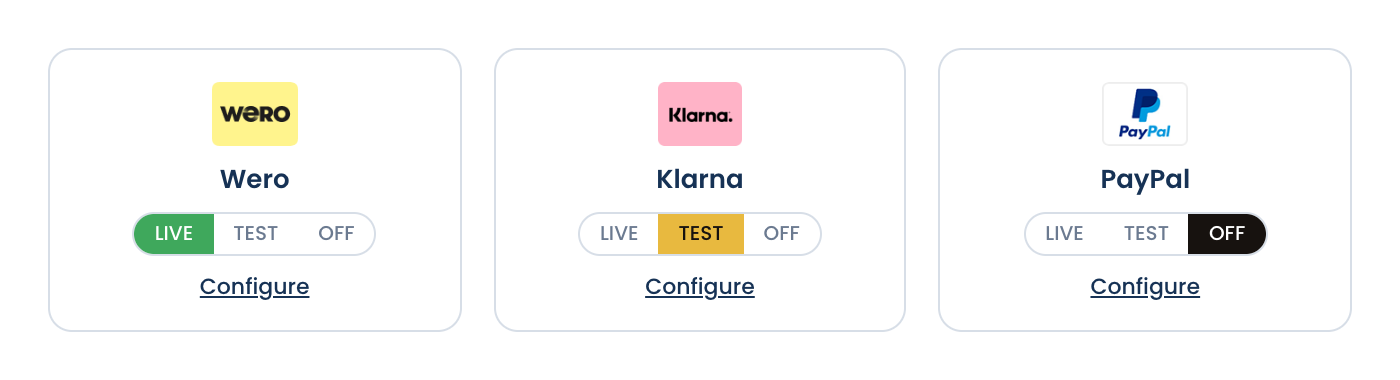
Settings every method has
| Setting | Default | What it does |
|---|---|---|
| Enabled | Off | Whether the method is available at all. |
| Test or Live | Test | Which Buckaroo environment the method uses. |
| Frontend label | The method's own name | The name shown to customers at checkout. |
| Buckaroo Fee | Empty | A fixed amount such as 2.50, or a percentage such as 3%. |
A newly enabled method defaults to Test, not Live. The method appears at checkout and the payment appears to work, but no money moves. This is the most common reason a live store takes no payments through a method someone just switched on. See Test and go live.
Fees use a full stop as the decimal separator, and any value containing % is treated as a percentage.
Two ways to offer cards
The extension has two separate cards for card payments, and the difference is not cosmetic: it decides whether the customer stays in your checkout.
Grouped cards is the Hosted Fields option. The customer enters their card number in your own checkout and the scheme is detected from it. This card needs a client ID and client secret, which are the Hosted Fields credentials, and it will not work without them.
Credit and debit cards lists each scheme you accept as its own option at checkout. The customer picks their scheme and is taken to complete the payment, so they leave your checkout.
Enable one, not both. Enabling both gives customers two routes to the same outcome, and the two routes behave differently, which makes the checkout harder to reason about for you as well as for them.
Grouped cards is the better experience for most stores, because staying in your checkout loses fewer customers. Separate schemes are worth it if you specifically want to steer customers towards or away from particular ones.
For what Hosted Fields does and what it requires, see Hosted Fields.
iDEAL | Wero collecting or processing
The iDEAL | Wero card has a Select Payment Type setting with two options: iDEAL | Wero Collecting and iDEAL | Wero Processing. Which applies to you depends on your Buckaroo agreement, so leave it on the default unless you have been told otherwise. The default is collecting via Buckaroo.
Methods with their own settings
- Riverty
Customer type, whether to authorise rather than charge immediately, whether to capture on shipment, and a financial warning option. - Billink
Customer type, authorise, financial warning, and whether to create the invoice after shipment. - Klarna
Whether to capture on shipment. Available on both Klarna cards. - Wero
Whether to authorise rather than charge immediately. - PayPal
Seller protection, plus the Express settings covered on Express checkout. - Apple Pay
Button placement and your Buckaroo Guid, also on Express checkout. - Pay by Bank
How the bank selection is displayed. - Bank Transfer
A due date in days, and whether a payment instruction email is sent. - PayPerEmail
Which payment methods the customer may use, an expiry in days, and whether the method is offered in your checkout as well as from the order screen. - Giftcards
Which giftcard brands you accept. - Bancontact
Whether the customer is redirected. - KBC
Whether the payment button is used.
Authorising rather than charging immediately means the money is reserved and collected later, which changes how the order is handled. See Order management.
A method must also be active at Buckaroo
Every supported method appears in the administration whether or not you can use it. Offering one in your checkout needs it active on your Buckaroo account, and some methods need a contract with the provider first.
For what each method supports and which countries it covers, see Payment methods.
Updated 1 day ago